
Art and the Occult Through the Ages: Part 2
Occultism, the belief of supernatural forces or beings, is not resigned to the history books, but is still widely present in modern society and continues to influence artists.
In part one I covered astrology, the zodiac, Satan and demonology depicted in art. In part two I will look at how ideas about witchcraft, alchemy and spiritualism have historically influenced artists, through to more recent times.
Alchemy
Alchemy was the medieval forerunner of chemistry. It's seen as a seemingly magical process of transformation, creation, or combination. An alchemist's work was to transmutate matter to produce a desired result such as a precious metal or a universal elixir. The discipline of manipulating physical matter was essentially equal parts scientific inquiry, philosophy and magic.
Early depictions of alchemy in art include David Teniers the Younger’s, The Alchemist c. 1643-45. The Flemish artist produced the painting around the time that many other 17th-century Dutch paintings were not only interested in the methods and theories of alchemy, but also fascinated by the intellects and characters behind the exploration of chemicals and their mysterious workshops.

Joseph Wright of Derby also created a painting in 1771, with an incredibly long title, known as The Alchemist Discovering Phosphorus for short. The painting employs the dramatic style of chiaroscuro (made famous by Rembrandt and Caravaggio) to create a drastic contrast between light and dark which was more often seen in religious paintings of the time.

Fast forward to more recent times, Jackson Pollock viewed his drip technique as an alchemical process as he transformed movement into autonomous, environmental experiences. His painting Alchemy (1947) was one of the first paintings he created using this methodology. The painting presents the idea that line no longer serves to describe shape but it exists as an autonomous event. The thickness of the line follows the movements of the artist’s body and gives way to the chance behavior of the medium.

Witchcraft
Ancient civilizations such as Mesopotamia, Egypt, and Rome are often considered the origins of witchcraft. These civilizations had practitioners of magic, known as magicians or priests, who used rituals to interact with divine powers.
During these eras, magical practices were considered part of religious and daily life. People involved in these practices were akin to alchemists: seen as respected figures who worked as healers and spiritual leaders, who used herbs and spiritual rituals to help their communities. Christianity later demonized these practices, especially in Europe which led to widespread witch hunts and trials in the Middle Ages, specifically between the 14th and 17th centuries.
In 1484, Pope Innocent VIII issued the papal decree Summis desiderantes affectibus, which authorized the persecution of witches. It described witchcraft as the existence of devils taking the shape of women. Shortly following this, The Malleus Maleficarum, was an infamous book, published in 1486, that served as a handbook for hunting and prosecuting witches. This led to a wave of new art depicting witchcraft.
The Four Witches by Albrecht Dürer 1497, is an engraving that presents four nude females conspiring together with a grotesque horned devil peering out from the shadows.

Witches' Sabbath by Frans Francken, painted in 1606, is another example that shows the social anxieties and superstitions that surrounded witchcraft in Europe at that time. The oil painting depicts a nocturnal gathering of witches engaged in sinister rituals.

Spiritualism and Mediumship
Spiritualism is a broader movement that focuses on communicating with spirits and the paranormal. Many creative professionals, from writers (Philip K Dick, Elizabeth Gilbert) to artist and musicians (Wolfgang Amadeus Mozart, John Coltrane) have stated they believe their inspiration was sourced from a universal creative intelligence, another entity or God. Spiritualists believe that they are conduits for this creative force.
British artist and medium Georgiana Houghton lived in London at the height of the Victorian spiritualism craze in the 1800s. During private séances she produced abstract watercolor works, that she called ‘spirit drawings’. She claimed that the drawings were produced by an automatic process, under the guidance and direction of spirits that used her as a vessel.
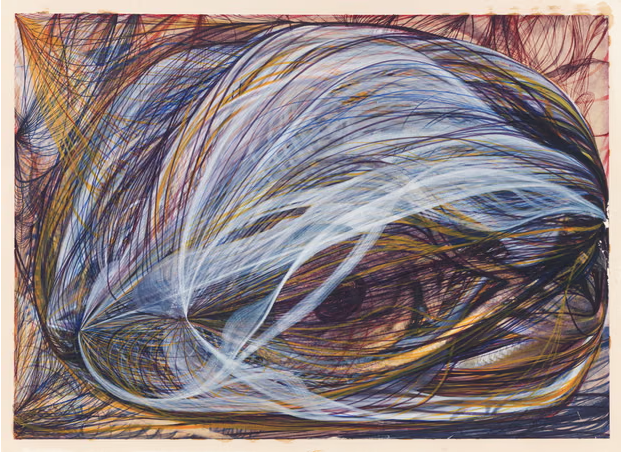
Swedish artist, Hilma af Klint (1862-1944), graduated from Stockholm’s Royal Academy of Fine Arts in 1887. She was an established artist in the country, known as a conventional figurative painter to her contemporaries. However, she quietly worked away at a secret body of work. This work she stated was created via the instruction of spiritual guides or, as she called them, ‘High Masters’. These guides had communicated with her via a device called a psychograph which is designed to enable psychic communication. To protect her reputation these paintings were only shown to others interested in spiritualism and were not allowed to be shown to the public until at least 20 years after her death.

Where does your inspiration come from? Are you a conduit for a creative higher being or a universal intelligence? Leave your comments below!


Amazing blog!